

Eyes, stars, horses, pigeons and witty phrases: the painted trucks of Egypt's roads are a moving gallery of folk art, and an amulet against the evil eye.
Drive the desert road from Cairo to Alexandria, and sooner or later you will find yourself behind a terella. The word comes from "trailer", and it means the great trucks that carry Egypt's goods along its highways: huge, wobbly, often loaded far higher than seems possible, with a container or two swaying on the back.
Look closer, though, and you will see that its back and sides are painted like a canvas. Eyes stare out at you. Stars, crescents and stripes in red, yellow and green run along the edges. Horses gallop, pigeons fly, flowers bloom, and somewhere among them, in bold Arabic letters, a phrase makes you smile. Egypt's roads are lined with one of its liveliest galleries of folk art, and it moves at eighty kilometres an hour.
Why paint a truck?
Part of the answer is practical. The designs are painted in bright, reflective and glowing colours that catch the headlights at night, and on dark desert roads that keeps the truck, and its driver, visible and safe.
There is also a much older reason. The art is meant to overwhelm you. So many colours, patterns and images compete for your attention that your gaze cannot settle on the truck itself, and so it cannot carry envy. In Egypt this envious gaze is called hasad, or the evil eye, and the belief that a jealous look can bring bad luck to whatever it falls on is thousands of years old. A truck is a driver's livelihood, often his family's whole fortune. Its decoration works as an amulet, a shield of colour against harm.
Reading a terella
Each truck is different, but the same symbols return again and again, and each one has a meaning.
- The eye. The most important of all. A painted eye watches back at the watcher, turning the evil eye away. It is the direct descendant of a protective sign Egyptians have worn for thousands of years, from the ancient Eye of Horus to the blue glass beads still sold in every market.
- The hand. An open hand with five fingers, often blue, is another ancient shield. In Egypt, the number five itself is said to ward off envy, and you may hear someone say "khamsa wa khmeesa", five and little five, when they want to protect something they love.
- Stars and crescents. Symbols of faith and of the night sky, and an echo of the decoration of mosques and homes.
- Horses. Strength, speed and endurance: everything a driver wishes for his truck.
- Pigeons and birds. Peace, home and freedom. Cairo's rooftops are full of pigeon towers, and the birds fly across the trucks too.
- Stripes and borders. Bright bands of colour that frame everything, and catch the light at night.
- Blue. Blue appears everywhere, because across the Mediterranean and the Middle East blue has long been believed to protect against the evil eye.
The words on the back
The phrases are the best part. Some are prayers and blessings: ma sha' Allah, what God has willed, the phrase every Egyptian uses to protect something beautiful from envy. Some are proverbs, some are the names of the driver's children, and many are pure Egyptian humour.
Our favourite is the one we chose for our hoodie: "rabbena yehmeeky men el mekaneeky", which means "may God keep you free from the mechanic's fee". It is a prayer, a joke and a piece of truck-driver philosophy all at once, and it rhymes. Others warn the driver behind to keep his distance, complain about envious neighbours, or simply announce that the truck is the pride of its owner.
A folk art on the move
Truck art belongs to a long tradition of decorating the things that matter most in everyday life. In the villages of Upper Egypt, families have long painted the outside walls of their homes with boats, planes, camels and the Kaaba to celebrate a member's return from the Hajj pilgrimage. Fishing boats are painted with eyes and names. Carts, tuk-tuks and microbuses carry their own stickers, slogans and charms.
The truck painters themselves are rarely famous. They work in roadside workshops on the edges of cities, painting from memory and by hand, each with his own style. A driver may come back to the same painter for years, and many drivers can tell who painted a truck just by looking at its back.
Why it inspired us
At Blue Cairo, we are drawn to the art that Egypt makes without calling it art: the tiles of a forgotten inscription, the flowers of an Ottoman pattern, the colours of a truck on the desert road. The terella seemed to us the perfect expression of the Egyptian spirit: chaotic, colourful, superstitious, practical and always ready with a joke.
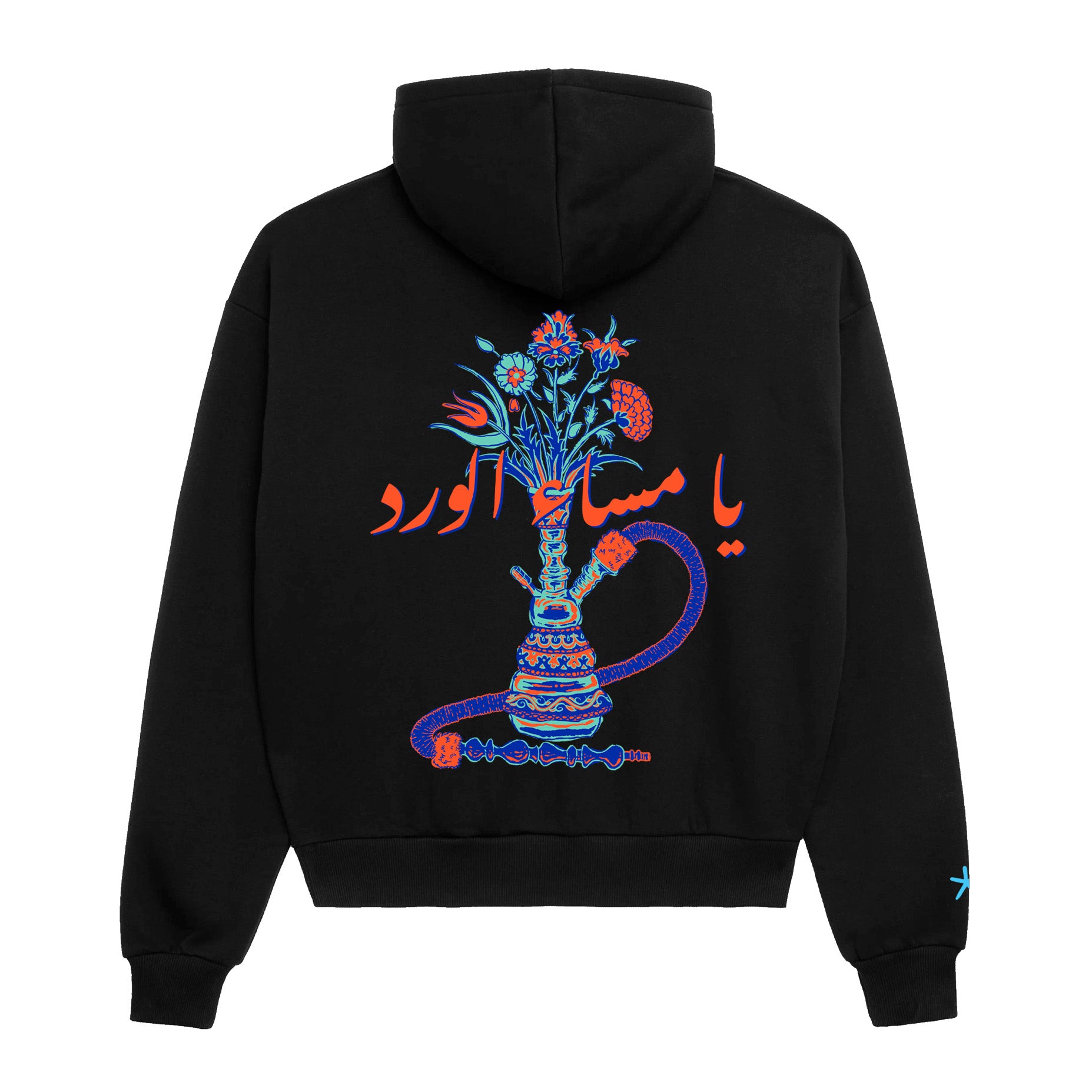
So we put it on a hoodie. The Terella gathers the eyes, stars, horses and pigeons of the road around the mechanic's prayer, so you can carry a little Egyptian luck with you. Explore it alongside the rest of our Egyptian art apparel, from the tiles of Al‑Qahirah to the ancient amulet on our Eye of Horus T-shirt.
And next time you are stuck behind a terella on the road, don't be annoyed. Read it.